
Desert ecosystems are among the most fragile on Earth. A single footprint on biological soil crust — the living layer of cyanobacteria, mosses, and fungi that holds desert soil together — can take 15 to 25 years to recover. A discarded plastic bottle in the Mojave may persist for 450 years. Yet these landscapes also rank among the most awe-inspiring places a person can visit: vast silence, sculpted rock, dark skies, and a rawness that makes every other environment feel cluttered by comparison. A sustainable desert trip lets you experience all of that while ensuring the landscape remains intact for the next visitor and the next generation. This guide covers how to plan, pack, travel, camp, and explore the desert responsibly — from the moment you leave your driveway to the moment you return home with nothing but photographs and memories.
Why Sustainability Matters More in the Desert
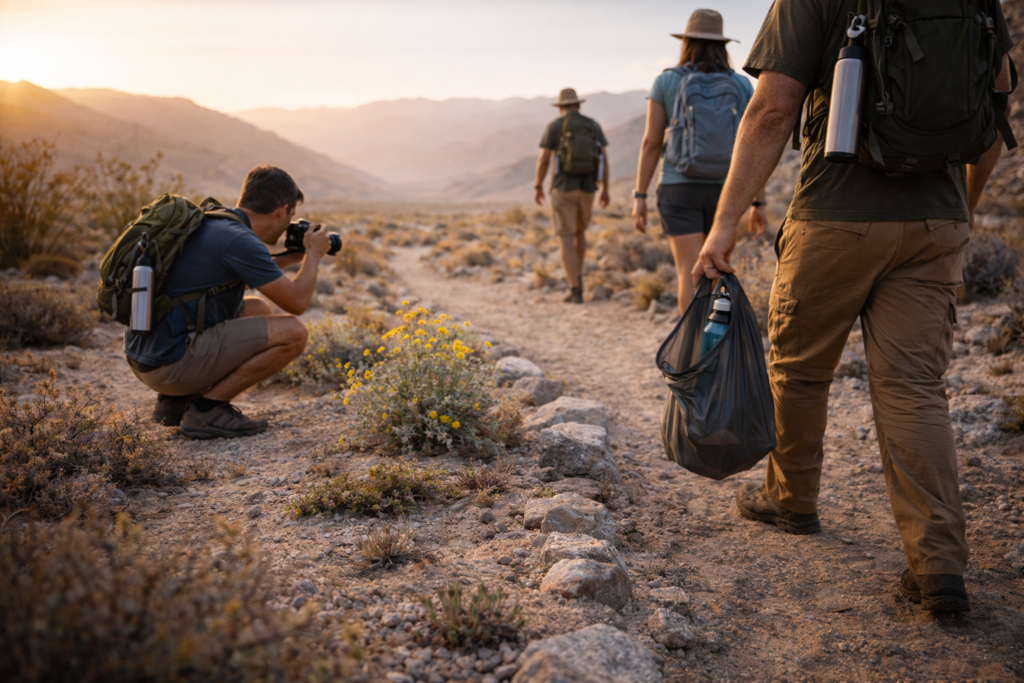
Visitors accustomed to lush, temperate environments often underestimate how vulnerable desert ecosystems truly are. Understanding the science behind that vulnerability is the first step toward traveling responsibly.
Recovery timelines are extreme. In a Pacific Northwest forest, a trampled patch of undergrowth may regrow within a single season. In the Sonoran or Chihuahuan desert, damaged vegetation can take decades to return. A mature Joshua tree grows as little as half an inch per year. A saguaro cactus may require 75 years to produce its first arm. When a vehicle drives off-road across undisturbed desert, the tire tracks can remain visible for 50 to 100 years because there is insufficient moisture, organic matter, and microbial activity to repair the compressed soil.
Water is scarce and shared. Desert springs, seeps, and ephemeral pools are critical lifelines for wildlife. Bighorn sheep, kit foxes, desert tortoises, and dozens of bird species depend on water sources that may be the only option for miles. Human contamination of even a single spring — through soap, sunscreen runoff, or waste — can cascade through an entire local ecosystem.
Visitation is surging. National parks and public lands in the American desert have experienced record-breaking visitation in recent years. Joshua Tree National Park recorded over 3 million visits in 2023. Death Valley, Anza-Borrego, and Big Bend have all seen significant increases. Higher foot traffic concentrates impact on trails, campsites, and fragile areas that were never designed for current volumes.
The good news is that sustainable desert travel doesn’t require sacrifice. It requires awareness, preparation, and a handful of intentional choices that often improve the quality of your experience.
Planning a Sustainable Desert Trip: Before You Leave Home
The most impactful sustainability decisions happen before you step onto sand. Smart planning reduces waste, lowers your carbon footprint, and prevents the improvised decision-making that leads to environmental damage in the field.
Choose Your Destination Thoughtfully
Not all desert destinations handle visitation equally well. Research parks and public lands that have invested in sustainable infrastructure — maintained trails, designated campsites, composting toilets, and visitor education programs. International Dark Sky Parks, Wilderness Study Areas, and lands managed under Leave No Trace partnerships tend to have the strongest conservation frameworks in place.
Consider visiting during shoulder seasons — October through November and March through April in the southwestern U.S. — when temperatures are comfortable but crowds are lighter than peak winter months. Lower visitation means less trail erosion, less campsite competition, and less strain on limited water and waste infrastructure.
Reduce Your Carbon Footprint Getting There
Transportation is the single largest carbon contributor of any trip. If your destination is within 300 miles, driving a fuel-efficient or electric vehicle is typically the lowest-emission option compared to flying. Carpool with friends or fellow hikers to divide per-person emissions. If you fly, consider purchasing verified carbon offsets through programs like Gold Standard or Verra — while offsets are imperfect, they channel funding toward renewable energy, reforestation, and methane capture projects.
Once on-site, consolidate your driving. Plan your itinerary so that trailheads, viewpoints, and campsites are clustered logically rather than criss-crossing the park multiple times. Many desert parks are vast — Death Valley spans over 3.4 million acres — and unnecessary driving adds both emissions and wildlife collision risk on remote roads.
Pack Zero-Waste Essentials
Every item you bring into the desert must eventually come out. Minimize packaging before you leave home by transferring snacks into reusable silicone bags or containers, filling a hard-sided water bottle or hydration reservoir instead of buying disposable plastic bottles, and packing a set of reusable utensils, a cloth napkin, and a small camp towel. Bring a dedicated trash bag and a separate bag for recyclables. If you generate it, you carry it — including fruit peels, nut shells, and food scraps that many hikers mistakenly believe are “biodegradable” in the desert. In arid conditions, an orange peel can take up to two years to decompose, attracting non-native rodents and disrupting local food chains in the meantime.
On the Trail: Low-Impact Hiking Practices
Once you’re on the ground, your choices at every step — literally — determine your impact on the landscape.
Stay on established trails. This is the single most important rule of desert hiking. Stepping off-trail crushes biological soil crust, compacts soil that may take a century to recover, and creates “social trails” that encourage future visitors to wander into sensitive areas. When trails are wide enough, walk single file through the center rather than widening the path at the edges.
Don’t stack rocks or build cairns. Decorative rock stacking has become a social media trend that actively damages desert habitats. Overturning rocks destroys microhabitats for insects, lizards, scorpions, and small mammals that shelter beneath them. In areas with cultural significance, rock disturbance may also violate federal antiquities laws. Cairns placed by land managers serve as trail markers — adding your own creates navigation confusion that can lead hikers off-route into fragile terrain.
Give wildlife space and priority. The U.S. Fish and Wildlife Service recommends maintaining a minimum distance of 100 feet from desert wildlife and never approaching, feeding, or following animals. Desert tortoises, a threatened species, can lose critical water reserves if they void their bladder in a fear response caused by human proximity. Bighorn sheep may abandon water sources if they associate them with human presence. Use binoculars or a telephoto lens instead of your feet.
Leave all natural and cultural objects in place. Desert wildflowers, fossils, rocks, pottery shards, and petroglyphs are protected by law on all federal and state lands. Removing a single artifact from an archaeological site can result in fines up to $100,000 under the Archaeological Resources Protection Act. Even seemingly insignificant items — a colorful stone, a sun-bleached bone — play ecological roles where they lie.
Sustainable Camping in the Desert
Where and how you camp has a direct, measurable impact on desert health. These practices apply whether you’re in a developed campground or a dispersed backcountry site.
Use Established Campsites
Always camp on previously disturbed ground — a designated site, an existing pullout, or a surface of durable rock or dry wash gravel. Never clear vegetation, move rocks, or flatten a new area to create a campsite. In popular dispersed camping corridors, choose a site that already shows signs of prior use rather than pioneering a new one.
Manage Water With Care
Carry all the water you need rather than relying on desert springs. If you must filter or collect water from a natural source, do so at least 200 feet downstream from the source point to minimize disturbance to wildlife that depends on it. Never use soap — even biodegradable soap — directly in or near a water source. Wash dishes and yourself at least 200 feet from any water, scattering strained dishwater broadly over dry ground.
Practice Proper Waste Disposal
Human waste is one of the most persistent contamination threats in desert environments, where low moisture and UV exposure slow decomposition dramatically. In many desert parks, pack-out waste systems (WAG bags) are required — and they should be your default even where they are not mandated. If catholes are permitted, dig six to eight inches deep in mineral soil at least 200 feet from water, trails, and campsites. Pack out all toilet paper in a sealed bag; burying it in arid soil is not sufficient for decomposition.
Minimize Campfire Impact
Many desert areas prohibit open fires entirely due to extreme wildfire risk and the scarcity of burnable wood. Where fires are permitted, use an existing fire ring, burn only small pieces of dead and downed wood, and burn all wood completely to white ash. Never burn trash — partially burned packaging is one of the most common forms of litter found in desert campsites. A portable camp stove is a lower-impact, more reliable alternative in virtually every desert scenario.
Sustainable Desert Photography and Social Media
The intersection of social media and outdoor recreation has created a new category of environmental impact that didn’t exist a decade ago. Geotagging fragile locations, promoting off-trail access for “the shot,” and staging photographs in sensitive areas have led to measurable damage at desert destinations worldwide.
Think before you geotag. Sharing the exact coordinates of a hidden slot canyon, a remote hot spring, or a fragile wildflower bloom can drive hundreds of unprepared visitors to a site within days of a viral post. Consider tagging the broader region — “Anza-Borrego Desert” — rather than the specific trailhead or GPS pin.
Never leave the trail for a photograph. No image is worth crushing biological soil crust, trampling wildflowers, or disturbing a nesting site. Use a telephoto lens to capture distant subjects and accept that some compositions are not accessible without causing harm.
Use your platform to model responsible behavior. If you share desert content online, include a brief note about Leave No Trace principles, staying on trail, or packing out waste. Normalizing sustainable behavior reaches more people than any sign at a trailhead.
Supporting Local and Indigenous Communities
A truly sustainable desert trip extends beyond environmental impact to include the human communities that call these landscapes home.
Spend money locally. Buy fuel, food, and supplies in desert gateway towns rather than stocking up entirely at a big-box store before you leave the city. Eat at locally owned restaurants. Book stays at independent lodges, locally operated campgrounds, and community-supported vacation rentals.
Respect Indigenous lands and cultural sites. Much of the American desert holds deep cultural significance for Native American nations, including the Cahuilla, Tohono O’odham, Navajo, Hopi, and many others. Some sites are sacred and not meant for casual visitation. Follow all posted access restrictions, never touch or photograph petroglyphs without checking local guidelines, and educate yourself on whose ancestral land you are visiting. Many tribal nations offer guided cultural tours that provide meaningful context while directing tourism revenue to Indigenous communities.
Frequently Asked Questions
What does “sustainable desert trip” mean?
A sustainable desert trip is any visit to an arid landscape planned and executed to minimize environmental impact, support local communities, and preserve the ecosystem for future visitors. It encompasses transportation choices, waste management, trail etiquette, campsite selection, water conservation, wildlife protection, and responsible social media sharing. The goal is to experience the desert fully while leaving no lasting trace of your presence.
How do I pack for a zero-waste desert trip?
Start by eliminating single-use packaging at home. Transfer food into reusable containers, carry a refillable water bottle or hydration bladder, and pack reusable utensils and a cloth napkin. Bring two dedicated stuff sacks — one for trash and one for recyclables. Include WAG bags for human waste, a small trowel if catholes are permitted, and sealable bags for used toilet paper. Avoid bringing glass containers, which create a serious hazard if broken on rocky terrain. Everything you carry in must come back out with you, including all food scraps.
Is it OK to use biodegradable soap in the desert?
Biodegradable soap still requires moisture, soil microbes, and time to break down — all of which are severely limited in desert environments. Never use any soap directly in a natural water source. Carry water at least 200 feet away from springs, streams, and seeps before washing. Use the smallest amount of biodegradable soap possible, and scatter wastewater broadly over dry ground to maximize evaporation and dispersal.
Can I drive off-road in the desert sustainably?
In most cases, no. Off-road driving on undisturbed desert soil causes damage that persists for decades to over a century. Tire tracks compress biological soil crust, destroy root systems, and create erosion channels. If you want to explore unpaved roads, stay on designated routes marked as open on the land manager’s Motor Vehicle Use Map. Never create new tracks, and avoid driving on wet surfaces where ruts form more easily.
How do I offset the carbon footprint of my desert trip?
Calculate your trip’s approximate emissions using a free carbon calculator such as those offered by the EPA or Gold Standard. Then purchase verified carbon offsets equivalent to your total emissions. Look for offsets certified by Gold Standard, Verra (VCS), or the American Carbon Registry, which fund projects like renewable energy development, methane capture, and reforestation. While offsets are not a substitute for reducing emissions directly, they channel real funding toward climate mitigation when combined with efficient travel choices.
What are the Leave No Trace principles for desert hiking?
The seven Leave No Trace principles apply everywhere, but carry special weight in the desert: plan ahead and prepare, travel on durable surfaces, dispose of waste properly, leave what you find, minimize campfire impacts, respect wildlife, and be considerate of other visitors. In desert environments, “travel on durable surfaces” is particularly critical — biological soil crust, once crushed, can take 15 to 25 years or more to regenerate. Staying on established trails is the single most impactful behavior you can adopt.
Make Your Next Desert Trip a Sustainable One
The desert asks very little of its visitors — stay on the trail, carry out what you carry in, leave the silence undisturbed. In return, it offers an experience no other landscape can match: the slow unfurling of a galaxy overhead, the echo of footsteps in a sandstone canyon, the sight of a desert tortoise crossing a wash at its own ancient pace.
Every choice you make on your next trip — from the vehicle you drive to the trail you walk to the photograph you share — either preserves that experience for the people who follow or chips away at it. The desert cannot absorb carelessness the way a temperate forest can. It remembers every footprint.
Start planning your sustainable desert trip today. Choose a certified Dark Sky Park or a Leave No Trace destination. Pack your reusable gear. Download offline maps and the land manager’s regulations before you leave cell range. Tell someone where you’re going. And when you arrive, slow down. The desert rewards patience — and it remembers those who treat it with care.
Leave nothing. Take nothing. Experience everything.